Fast Food Menus, Prices and Local Favorites
A paper bag on the passenger seat. Fries going soft by the second red light. A receipt nobody reads.
That small ritual plays out millions of times a day across North America, and most of it happens at restaurants a few miles from home. Menufo exists for that moment. This page is the starting point for every fast food menu on the site, from the national chains everyone knows to the local burger stands that only their own city talks about.
You will find full menus, current price estimates, opening hours and short histories for each restaurant. Every brand has its own hub page, and every hub links to a complete menu page plus individual posts on the items people search for most.
What Counts as Fast Food on Menufo
Fast food, for this site, means limited-service restaurants: you order at a counter, a kiosk, an app or a drive-thru speaker, and the food comes to you quickly without table service. That definition covers burger stands, fried chicken shops, taco counters, pizza carryout, sub shops and coffee drive-thrus.
The plan is to also cover the growing group of fast casual chains such as Chipotle Mexican Grill and Panera Bread. These restaurants sit at a slightly higher price point, but customers still order at the counter and carry their own tray, so they belong here.
Full-service restaurants with servers and table orders fall outside this hub. Where a brand runs both formats, the menu pages focus on the counter and drive-thru menu.
We’ve added a few fast-food chains so far, but we’ll be adding more over time.
We Don't Miss the Local Favorites
Most fast-food websites start by covering big names like McDonald’s. But at Menufo, we started with two regional favorites.
The first two of the restaurants on this site comes from California, where a large share of American fast food history began and where regional chains still draw lines around the block. From there, coverage expands city by city across the United States and Canada, with a goal of documenting 500 local fast food chains that people in each region know by name.
A local chain might have six locations or sixty. What qualifies it is reputation inside its own area: the burger stand that residents send out-of-town visitors to, the taco shop that has run the same menu board since the 1970s, the drive-thru that opens before sunrise for the commuter crowd.
These restaurants rarely get the menu coverage the national brands receive. Their websites are often thin, their prices change without announcement, and their item names only make sense to regulars. Menufo fills that gap with full, organized menus and plain explanations of what each item contains.
National chains are still part of the picture. When a multinational brand is the go-to option in a city, it gets the same full treatment as a local stand.
How to Use This Fast Food Hub
Every restaurant on Menufo follows the same three-level structure, so once you learn one brand, the rest work the same way.
The Brand Hub Page
Each restaurant has a hub page at /fast-food/ followed by the brand name. The hub covers the restaurant's history, where it operates, what it is known for, and the latest posts written about it. If you want a quick overview before you order, start here.
The Full Menu Page
Every hub links to a complete menu page. Menus are grouped by category, such as burgers, chicken, breakfast, sides, drinks and desserts, with item descriptions and price estimates. Vegetarian options, combo meals and add-ons get their own lists so you can scan them quickly.
Individual Item Posts
Popular food items get their own posts. These cover what comes on the item, current price estimates, calories where the restaurant publishes them, and how the item compares to similar options on the same menu. If you have ever wondered what exactly sits inside a regional specialty with an unusual name, these posts answer that.
Prices, Hours and Updates
The prices listed across Menufo are estimates based on recent menus, third-party ordering platforms and in-store checks. Fast food pricing varies by location, so the number you see at your local counter may sit slightly above or below the figure on the page. Each menu page shows when it was last reviewed, which helps you judge how current the numbers are.
American Fast Food Culture
Every country eats quickly. The United States turned eating quickly into an industry, a landscape and a shared language. To understand why a burger stand in Southern California can have a longer line than a sit-down steakhouse, it helps to look at how that happened.
It Started With a Castle in Kansas
White Castle opened in Wichita, Kansas, in 1921, and most historians treat it as the first fast food chain. Founders Billy Ingram and Walt Anderson sold small hamburgers from a clean, uniform building, cooked in plain view of the customer. The company still documents that early period on its own White Castle history page.
That visible kitchen had a purpose. Ground beef carried a poor reputation in the early 1900s, and White Castle used spotless white interiors and standardized cooking to win public trust. The formula of a short menu, fixed process, identical buildings and low prices became the template that almost every fast food chain still follows.
Trust came first. Speed came right after.
California Built the Drive-Thru
The modern fast food model took shape in Southern California after World War II. Suburbs spread, freeways went in, and car ownership climbed. Restaurants followed the cars.
In 1948, Richard and Maurice McDonald shut their San Bernardino drive-in and reopened it with a trimmed menu and an assembly-line kitchen built around speed. The same year, Harry and Esther Snyder opened In-N-Out Burger in Baldwin Park, California, with a two-way speaker that let drivers order without leaving the car or waiting for a carhop. That speaker box became the basis for drive-thru ordering across the industry, and the full timeline appears on the In-N-Out Burger history page.
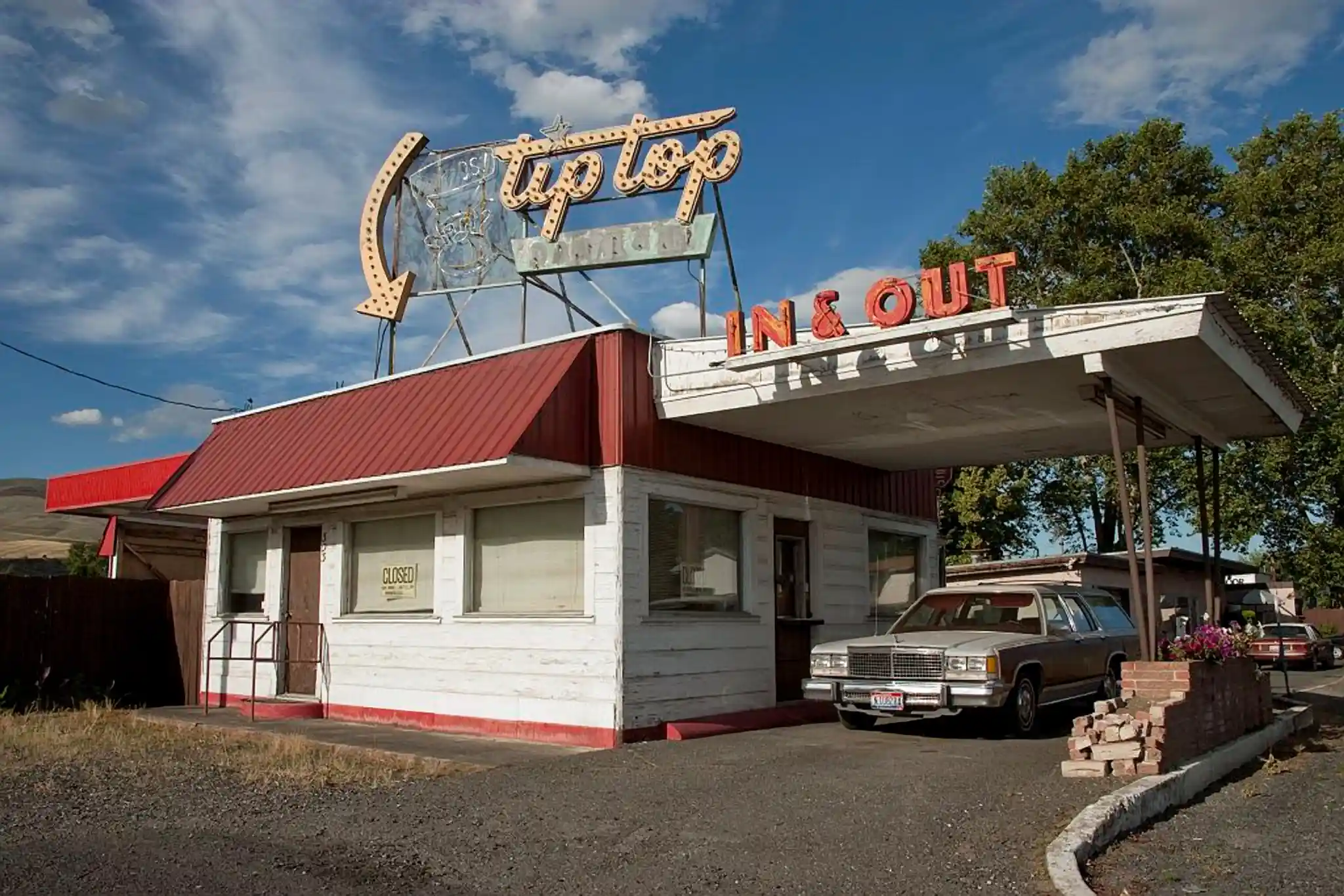
Picture Source: https://pxhere.com/en/photo/682137
The rest of the decade filled in quickly. Jack in the Box opened in San Diego in 1951 with a drive-thru built around a talking clown head. Taco Bell followed in Downey in 1962. Ray Kroc began franchising McDonald's nationally from Des Plaines, Illinois, in 1955, carrying a Southern California idea to the rest of the country.
A surprising amount of American fast food history fits inside a two-hour drive of downtown Los Angeles. That is one reason Menufo started there.
The Highway Did the Rest
Federal highway construction in the 1950s and 1960s changed how Americans traveled, and fast food grew alongside it. Families on road trips needed meals that were cheap, quick and predictable. Chains placed restaurants at exits and intersections, and a recognizable sign became a promise about what would be inside.
Franchising scaled that promise. A local entrepreneur could buy into a proven system, and the brand could grow without building every location itself. By the 1970s and 1980s, chains had reached nearly every American town and had started expanding across Europe, Asia and Latin America.
Pizza delivery from chains such as Domino's and Pizza Hut added another layer: fast food that came to the front door. Decades later, apps and third-party delivery extended the same idea to almost every brand on this page.
The Same Burger, Every Time
Consistency sits at the center of American fast food culture. A cheeseburger ordered in Ohio should taste like the one ordered in Oregon, and the large chains spend heavily to make that happen through fixed recipes, supplier contracts, training programs and timed cooking procedures.
That consistency explains why fast food often works as comfort food. People return to the order they already know. Many have a standing order at two or three restaurants that has not changed in years.
It also explains the culture around secret menus and custom orders. When the base menu stays fixed, regulars find their own variations, and some of those variations eventually get printed on the official menu board.
Regional Pride and Fast Food Loyalty
National chains dominate sales charts, but regional chains hold an outsized place in local identity. Texans argue about Whataburger. Californians debate In-N-Out Burger orders. Wisconsin residents line up at Culver's for butter burgers and frozen custard, and much of the Carolinas start the day with a Bojangles biscuit.
Those loyalties travel. Residents who move away often list a regional chain among the first things they look for on a return trip, and fans of a particular chain follow its expansion into new states closely. This regional attachment is the part of fast food culture that national menu sites tend to skip, and it is the part Menufo covers in the most detail.
Fast Food Today
Fast food remains a daily habit for a large share of the country. A 2025 National Center for Health Statistics data brief found that 32 percent of American adults ate fast food on a given day between August 2021 and August 2023. Fast food supplied about 11.7 percent of adults' daily calories over that period, and the share was highest among adults aged 20 to 39, at 15.2 percent.
The format keeps adjusting to how people order. Drive-thru lanes now handle most traffic at many locations, mobile apps carry a growing share of sales, and loyalty programs and app-only deals shape what people pay. Menus have widened too, with plant-based options, spicy chicken sandwiches, specialty coffee drinks and global flavors appearing next to the burgers and fries that started it all.
The paper bag on the passenger seat survives every change.
Top Fast Food Chains in the USA
The ranking below uses QSR magazine's 2026 QSR 50 report, which ranks limited-service chains by 2025 U.S. systemwide sales. Systemwide sales include company-owned and franchised locations combined, which makes it the most common way to compare chain size. QSR estimated the figures for some brands, including Starbucks, Chick-fil-A and Subway, where the company did not submit numbers.
| Restaurant | Category | 2025 U.S. Sales | U.S. Locations |
|---|---|---|---|
| McDonald's | Burgers | $55.1 billion | 13,706 |
| Starbucks | Coffee and snacks | $30.3 billion | 16,860 |
| Chick-fil-A | Chicken | $23.9 billion | 3,287 |
| Taco Bell | Mexican-inspired | $17.2 billion | 7,784 |
| Dunkin' | Coffee and snacks | $13.1 billion | 9,999 |
| Wendy's | Burgers | $11.9 billion | 5,969 |
| Chipotle Mexican Grill | Mexican-inspired | $11.7 billion | 3,938 |
| Burger King | Burgers | $11.1 billion | 6,649 |
| Domino's Pizza | Pizza | $10.0 billion | 7,186 |
| Subway | Sandwiches | $9.2 billion | 18,773 |
What the Top 10 List Shows
McDonald's leads by a wide margin, with sales close to the next two brands combined. Its lead comes from both scale and traffic, as it runs more than 13,700 U.S. restaurants with average sales of about $4.1 million per location.
Chick-fil-A holds third place with far fewer restaurants than its neighbors on the list. The chain's 3,287 locations averaged roughly $7.7 million each, the highest per-restaurant figure among the major brands, even though every location closes on Sunday.
Subway runs more U.S. locations than any other chain on the list, at 18,773, yet ranks tenth in sales. Its average location brings in about $490,000 a year, and the chain closed more than 700 U.S. locations during 2025.
Two coffee brands, Starbucks and Dunkin', sit inside the top five. Their presence reflects how much of fast food spending now happens before lunch.
Top Burger Chains
Burgers remain the largest and most crowded category. After McDonald's, Wendy's and Burger King, the next tier of burger chains by 2025 U.S. sales looks like this:
- Sonic Drive-In: $5.2 billion
- Dairy Queen: $5.0 billion
- Whataburger: $4.3 billion
- Jack in the Box: $4.2 billion
- Culver's: $4.2 billion
- In-N-Out Burger: $2.6 billion (QSR estimate)
- Five Guys: $2.3 billion
In-N-Out Burger stands out in this group. With only 431 locations, all company-owned, its restaurants averaged an estimated $6 million each, which places it near the top of the entire industry on a per-location basis.
Top Chicken Chains
Chicken has been the fastest-moving category of the past decade, driven by chicken sandwiches, tenders and wings. Behind Chick-fil-A, the leading chicken chains by 2025 U.S. sales are:
- Popeyes Louisiana Kitchen: $5.7 billion
- Raising Cane's Chicken Fingers: $5.5 billion
- Wingstop: $5.3 billion
- KFC: $4.7 billion
- Zaxby's: $2.8 billion
- Bojangles: $1.9 billion
Raising Cane's Chicken Fingers runs a menu built almost entirely around chicken tenders, and its average location brought in about $6.6 million. Wingstop added 382 U.S. locations in 2025, more than any other chicken brand on the list, while KFC reported a net decline of 146 locations.
Top Pizza Chains
Pizza chains lean heavily on delivery and carryout, and the top of the category has stayed stable for years:
- Domino's Pizza: $10.0 billion
- Pizza Hut: $5.1 billion
- Papa Johns: $3.7 billion (QSR estimate)
- Little Caesars: $3.7 billion (QSR estimate)
- Marco's Pizza: $1.1 billion
Top Sandwich Chains
The sandwich category includes classic sub shops, roast beef and bakery-cafe formats. After Subway, the leaders are:
- Panera Bread: $5.9 billion (QSR estimate)
- Arby's: $4.2 billion
- Jersey Mike's Subs: $4.2 billion
- Jimmy John's: $2.7 billion
- Firehouse Subs: $1.2 billion
Jersey Mike's Subs added 238 locations in 2025 and now sits almost level with Arby's in total sales.
Top Mexican and Global Chains
Mexican-inspired chains make up most of this group, with Panda Express representing American Chinese food at a national scale:
- Taco Bell: $17.2 billion
- Chipotle Mexican Grill: $11.7 billion
- Panda Express: about $6.4 billion
- QDOBA Mexican Eats: $1.3 billion
- CAVA: $1.2 billion
- Del Taco: $0.9 billion
Taco Bell was founded in Downey, California, Panda Express started in Glendale, California, and Del Taco opened its first location in Yermo, California. All three trace back to the same Southern California fast food boom that produced McDonald's and In-N-Out Burger.
Local Chains Worth Knowing
National rankings measure size. Local reputation measures something else, and some of the restaurants with the strongest followings never appear near the top of a sales chart. These are a few of the regional chains Menufo covers in depth:
- In-N-Out Burger: founded in 1948 in Baldwin Park, California, known for a short menu and an unofficial secret menu
- Original Tommy's: a Los Angeles chili burger stand dating to 1946, with its first location still operating at Beverly Boulevard and Rampart Boulevard
- Bakers Drive-Thru: an Inland Empire chain from San Bernardino that serves burgers, Mexican food and breakfast from the same window
- Wienerschnitzel: a hot dog drive-thru that started in Wilmington, California, in 1961
- Whataburger: founded in Corpus Christi, Texas, in 1950 and closely tied to Texas identity
- Culver's: a Wisconsin chain that started in Sauk City in 1984, known for butter burgers and frozen custard
- Bojangles: a Charlotte, North Carolina, chain from 1977, built around Cajun-seasoned chicken and biscuits
Each of these has a hub page and a full menu on Menufo, and the list grows as coverage expands into new cities. For the full set of restaurants in your area, browse the brand hubs linked from this page.
Why Fast Food Prices Differ by Location
The same burger can carry a different price in two towns a few miles apart. Several factors explain the gap:
- Franchise pricing: most national chains are franchised, and franchise owners set their own prices within brand guidelines
- Local wages: states and cities with higher minimum wages tend to have higher menu prices, and California's fast food wage rules have pushed prices up across the state
- Rent and operating costs: airport, downtown and tourist locations usually charge more
- Delivery markups: prices on third-party delivery apps often run higher than in-store prices, before service fees are added
- App deals: many chains now reserve their lowest prices for loyalty members ordering through the official app
The prices listed on Menufo reflect typical in-store pricing for the region each restaurant serves. For an exact total, you can check the restaurant's own app or ask at the counter before ordering, since local promotions and taxes also change the final amount.